
Understanding Soil Compaction: The Hidden Threat Damaging Your Southern Lawn
Your lawn might look fine from a distance, but underneath the surface, something could be silently strangling your grass. Soil compaction is one of the most overlooked problems affecting Southern lawns. By the time you notice the symptoms, your turf has already been struggling for months.
What You Need to Know
- Soil compaction occurs when soil particles are pressed together, eliminating the pore space that grass roots need to access water, oxygen, and nutrients.
- Common warning signs include water pooling after rain, thin or patchy grass, hard soil that resists a screwdriver, and shallow root growth.
- Core aeration is the most effective treatment: it removes small plugs of soil to restore airflow and drainage, giving your lawn room to breathe and thrive again.
If you've noticed puddles forming on your lawn after a light rain, grass that refuses to green up despite proper watering, or soil so hard you can barely push a shovel into it, you're likely dealing with compacted soil. In our 28 years serving homeowners across Georgia, we've found that many lawn problems blamed on fertilizer deficiencies or disease actually stem from this hidden underground issue. The good news is that once you understand what's happening beneath the surface, the solution becomes clear.
What Is Soil Compaction and Why Does It Happen?
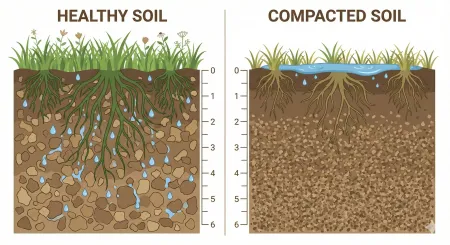
Soil compaction occurs when the particles that make up your soil get pressed together so tightly that the essential pore space between them disappears. According to the University of Delaware Cooperative Extension, "Half of a healthy soil's makeup is pore space, with the other half composed of organic matter and mineral particles" (Pineo and Barton). When this balance gets disrupted, your grass suffers.
Healthy soil acts like a sponge. It holds water when needed but also allows excess moisture to drain while maintaining air pockets for root respiration. Compacted soil behaves more like concrete, preventing water infiltration and blocking the oxygen exchange that roots need to survive.
Common causes of soil compaction include:
- Foot traffic from children playing, pets running, or regular walking paths across the lawn
- Vehicle and equipment weight from parking on grass, construction equipment, or heavy mowing machines, following the same route
- Clay-heavy soils are common throughout Georgia, Alabama, and South Carolina that naturally compact more easily than sandy soils
- Heavy rainfall that pounds bare soil surfaces, especially during our intense Southern thunderstorms
- Overwatering that keeps the soil saturated, making it more susceptible to compression
The Southeast's red clay soils present a particular challenge. As the University of Massachusetts Extension notes, soil compaction "can create turf management problems caused by alterations in the physical properties of the soil, including decrease in total pore space, decrease in soil oxygen content, and reduction in water infiltration and percolation rates" (UMass Amherst). These conditions are especially pronounced in our region's heavy clay soils.
How to Tell If Your Lawn Has Compacted Soil
Recognizing soil compaction early saves you time, money, and frustration. We've seen countless homeowners pour fertilizer and water onto their lawns, trying to fix problems that actually require aeration. Here's what to look for:
Visual signs you can spot from your window:
- Water pooling or puddling on the lawn surface after rain or irrigation instead of soaking in
- Thin, patchy grass that fails to fill in despite seeding attempts
- Weeds that thrive in compacted conditions, like knotweed, goosegrass, and annual bluegrass taking over
- Bare spots in high-traffic areas where grass refuses to grow
- Grass with a weak, yellow-green color, even when properly fertilized
Physical tests you can do yourself:
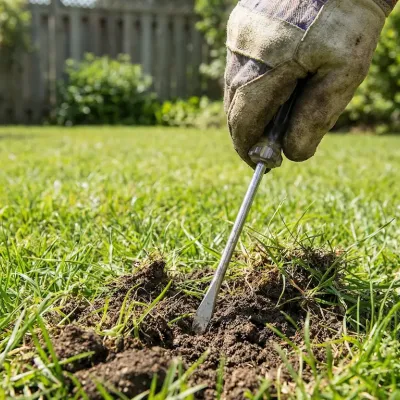
The simplest way to test for compaction is the screwdriver test. Push a regular screwdriver into moist soil. If you can easily insert it 4-6 inches deep, your soil is in decent shape. According to Rutgers University, "If the wire is pushed to a depth of 12 inches or more, then the soil is considered not compacted and in good condition... However, if the wire starts bending at a soil depth of less than 4 inches, the condition can be considered poor and compacted" (Rutgers NJAES). If you're meeting serious resistance within the first few inches, compaction is likely your problem.
You can also dig a small section of turf and examine the roots. Healthy grass roots should extend 4-6 inches deep. If your roots are stubby, horizontal, or clustered near the surface, compacted soil is preventing normal growth.
Why Compacted Soil Kills Your Grass
Understanding how compaction damages your lawn helps explain why simple solutions like more water or fertilizer don't work. The problem is mechanical, not nutritional.
Restricted root growth: Grass roots need loose soil to expand and establish a healthy network. Compacted soil physically blocks root penetration, forcing roots to stay shallow. Shallow-rooted grass is vulnerable to heat stress, drought, and disease.
Poor drainage and oxygen exchange: As Clemson University Extension explains, "Soil compaction in a turf area will destroy the structure of the soil, making it impervious to water infiltration, which causes runoff and possible erosion problems. Subsequently, the amount of air reaching the root system will be reduced, and this can result in a loss of roots" (Forrester). Roots that can't breathe essentially suffocate.
Reduced nutrient uptake: Even if nutrients are present in the soil, compacted conditions prevent roots from accessing them. UMass Extension research shows that "turfgrass nutrient uptake from compacted soils may be reduced by 10 to 30%" (UMass Amherst). This means your fertilizer investment is largely wasted until the compaction is addressed.
Increased disease susceptibility: Weakened grass with poor root systems becomes an easy target for fungal diseases like brown patch. Additionally, the moisture that pools on compacted soil creates ideal conditions for disease development.
How Core Aeration Fixes Compacted Soil
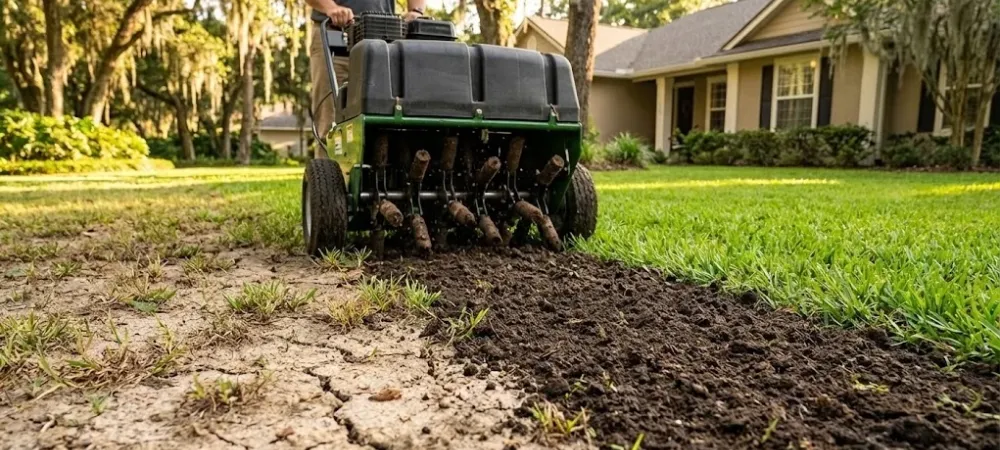
Core aeration is the gold standard treatment for compacted lawns. Unlike spike aeration, which can actually worsen compaction by pushing soil sideways, core aeration physically removes small plugs of soil from your lawn.
Here's how the process works:
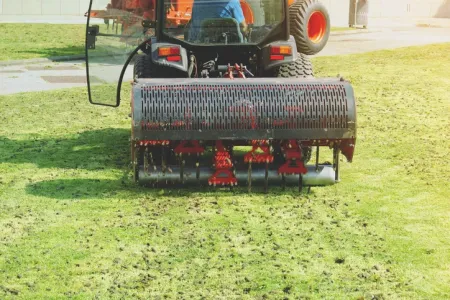
A professional core aerator machine drives hollow metal tines into the soil, extracting plugs approximately 2-4 inches long and depositing them on the surface. These plugs break down naturally over a few weeks, redistributing beneficial soil microorganisms. The holes left behind create channels for air, water, and nutrients to penetrate deep into the root zone.
In our experience treating thousands of lawns across Alabama, Georgia, and South Carolina, we've found that the benefits of professional lawn aeration services become visible within weeks. You and I both know that homeowners often notice improved color, denser growth, and better water absorption before the season ends.
Timing matters for Southern lawns:
For warm-season grasses like Bermuda, Zoysia, and Centipede, which dominate our region, the ideal aeration window is late spring through early summer when the grass is actively growing and can recover quickly. For fescue lawns in the upper South, early fall aeration produces the best results. You can learn more about the benefits of lawn aeration on our blog.
How to Prevent Soil Compaction
While some compaction is inevitable, especially in clay soils, smart lawn management reduces the problem significantly:
- Vary your mowing pattern each time you cut to avoid creating compacted wheel tracks
- Limit foot traffic by creating defined pathways using stepping stones or mulch
- Avoid working wet soil by staying off the lawn when it's saturated from rain or irrigation
- Keep grass height at 3+ inches to promote deeper root growth that helps resist compaction
- Schedule annual or biannual aeration as a preventive measure, not just a cure
- Add organic matter through proper lawn fertilization programs to improve soil structure over time
- Test your soil periodically, and our guide to winter soil testing can help you stay ahead of problems
When to Call a Professional
DIY aeration with a manual tool or rental machine can help small areas, but for significant compaction problems or lawns larger than a few thousand square feet, professional equipment makes a meaningful difference. Our step-by-step aeration guide explains when professional help delivers better results.
Consider professional aeration if:
- Water consistently pools on your lawn despite proper grading
- Your grass has remained thin and weak for multiple seasons
- You've tried fertilizing and watering without improvement
- High-traffic areas won't recover no matter what you do
- Your lawn covers more ground than a push aerator can handle efficiently
Give Your Lawn Room to Breathe
Soil compaction doesn't fix itself. Without intervention, the problem worsens year after year, making your lawn more vulnerable to drought, disease, and weed invasion. But with proper aeration and ongoing care, even severely compacted lawns can recover and thrive.
At Unlimited Lawn Care™, we've helped homeowners across Georgia transform struggling, thin lawns into thick, healthy turf for over 28 years. Our lawn aeration and overseeding services address compaction at its source while setting your grass up for long-term success.
Ready to see the difference proper aeration makes? Contact us today for a free lawn evaluation, and let's get your grass growing the way it should.
Sources
- Forrester, Gary. "Turfgrass Cultivation." Clemson University Cooperative Extension Home & Garden Information Center, HGIC 1226, May 2016.
- Pineo, Rebecca, and Susan Barton. "Combating Soil Compaction." University of Delaware Cooperative Extension, Oct. 2024.
- Rutgers New Jersey Agricultural Experiment Station. "Assessing and Addressing Soil Compaction in Your Yard." FS1313.
- University of Massachusetts Amherst Extension. "Compaction and Cultivation." UMass Center for Agriculture, Food, and the Environment, 2011.